

There is a specific kind of frustration that hits med spa owners around month three or four.
The clinic looks exactly how you imagined it. The injectors are trained. The equipment cost more than a car. Clients who walk through the door leave happy. And still, the appointment calendar has gaps that should not be there.
The problem rarely comes from the quality of the work. It comes from one thing: the right people in your city cannot find you on Google.
Right now, someone two streets from your clinic has typed “Botox near me” into their phone. She is looking at the top three results. She is going to call one of them. The question is whether your clinic is in that list or not.
That is the gap this guide is built to close.
We work with service businesses across the United States, and the med spa industry has an entirely fixable visibility problem. The clinics that have done the work consistently dominate their local search results. The ones that have not are watching competitors win clients that should have been theirs.
This guide covers everything your med spa needs to rank on Google in 2026, from how the map pack works to keyword strategy by treatment type, to the seasonal publishing calendar most clinics have never thought about.
Understanding why digital marketing drives new client acquisition is simple: your next client is searching for you right now. The question is whether she finds you or your competitor.
The Google Map Pack: What It Controls and How Med Spas Win It
Before getting into tactics, understand the one result that drives most med spa bookings.
When someone searches “med spa near me” or “lip fillers in Austin,” Google shows two types of results. At the top is the map pack: three listings with a map, star ratings, and contact details. Below that are the regular website results.
The map pack gets the majority of clicks. Most people search on their phone, see those three listings, and call one without scrolling further. If your clinic is not in those three results, most local searchers will never know you exist.
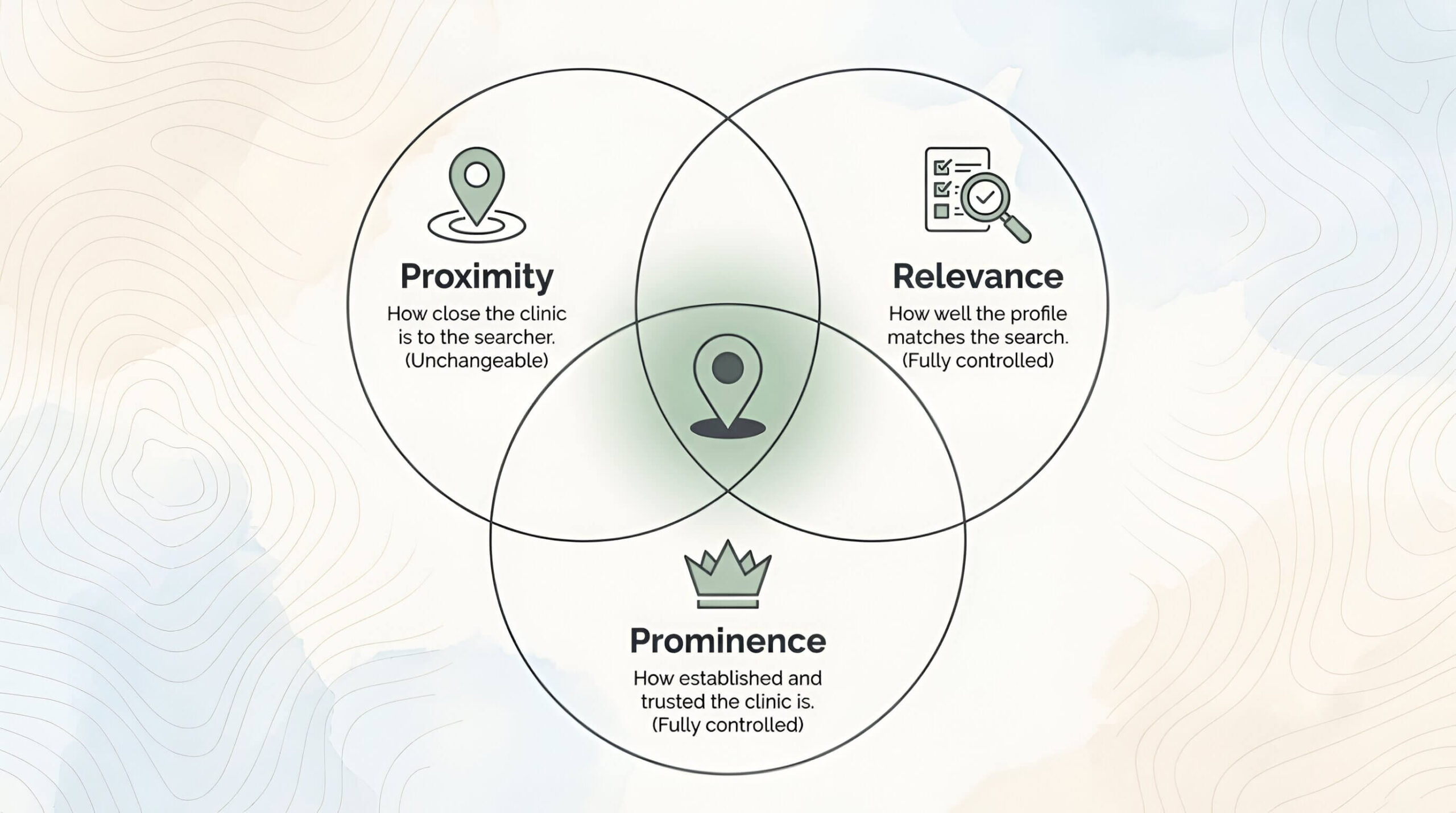
Google decides which three clinics appear using three signals:
- Proximity: how close the clinic is to the searcher. You cannot change this.
- Relevance: how well your profile matches what was searched. You control this completely.
- Prominence: how established and trusted your clinic appears across the web. You control this too.
The clinics that dominate the map pack in their city built relevance by optimising every part of their Google Business Profile. They built prominence through consistent reviews, accurate citations, and a website that backs up what their profile claims.
Knowing which businesses benefit most from local SEO comes down to how location-dependent the client base is. A med spa client has to visit in person. Every client acquisition is geographically tied. That makes local search the most important marketing channel your clinic has.
Keyword Research for Med Spas: Not Every Treatment Competes at the Same Level
Here is something most med spa SEO guides miss entirely.
When you offer twelve treatments, those twelve treatments do not compete equally on Google. “Botox near me” is one of the most competitive local searches in the US aesthetics industry. Established multi-location clinics dominate it in most cities.
“PDO thread lift in [your city]” is a completely different situation. Competition is a fraction of Botox. The client searching for it knows exactly what she wants. She is ready to book. And in most US markets, only two or three clinics have a dedicated page for this treatment.
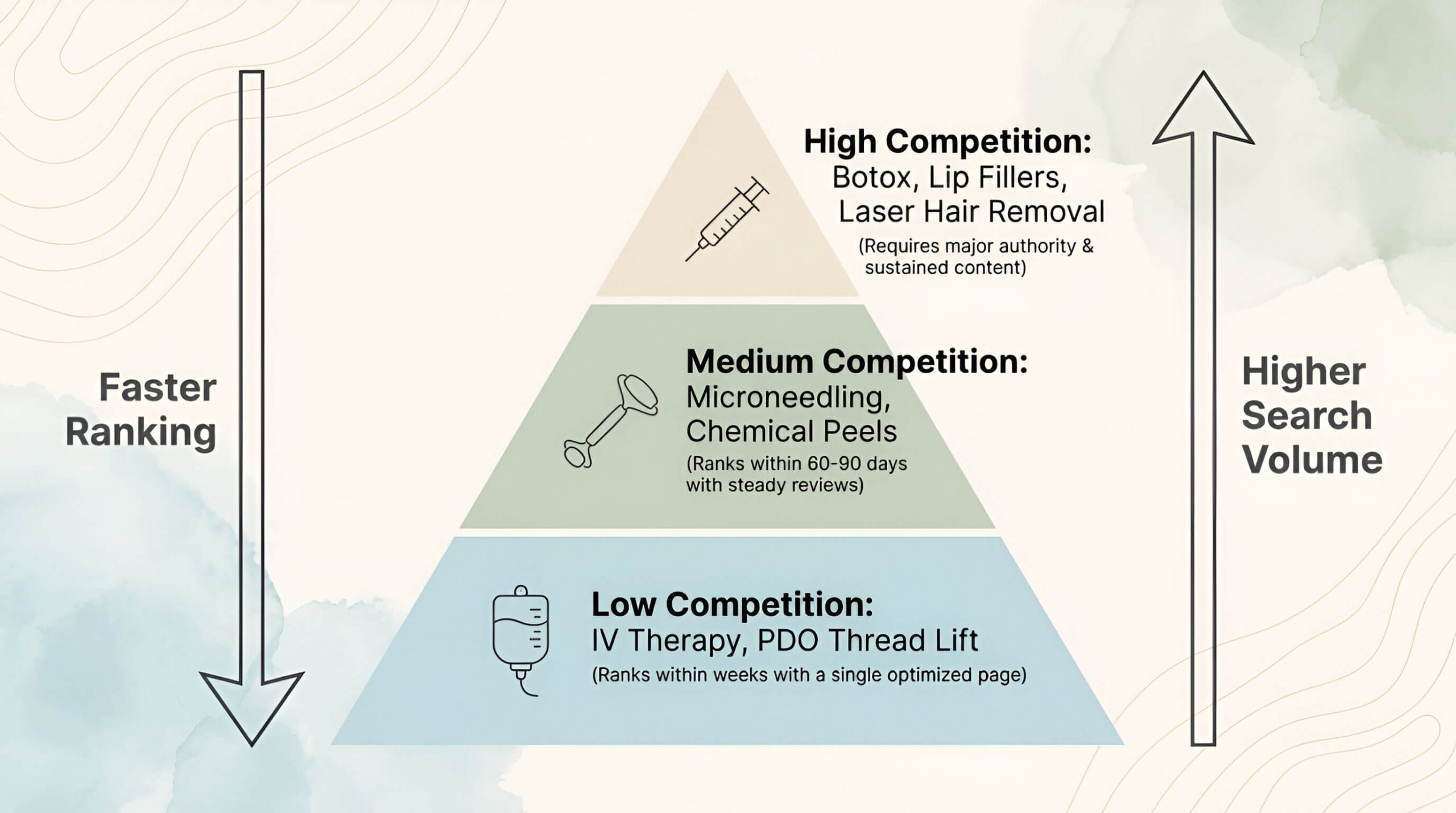
Your treatment menu is a keyword map with different levels of opportunity.
Three groups to think about
High competition: Botox, lip fillers, laser hair removal, HydraFacial. These searches have huge volume and major competition. You need them, but do not expect quick wins. Build toward them with strong GBP authority and sustained content output.
Medium competition: microneedling, chemical peels, body contouring. These rank within 60 to 90 days with a properly built service page and steady review growth.
Low competition: PDO thread lift, IV therapy, RF microneedling, laser for dark skin tones, treatment for rosacea or melasma. Search these terms in your city. Most return two or three results. A single well-built page can put you at the top within weeks.
The keyword formula every treatment page needs
Treatment name plus city plus state. “Botox injections in Dallas, TX.” “Microneedling in Phoenix, AZ.” “IV therapy med spa in Nashville, TN.”
That combination goes in your H1 title, your page title, and your first paragraph. It is not complicated. It is just not done by most med spas, which is exactly why the opportunity is still there.
Long-tail keywords convert faster than short-tail. “How much does Botox cost in [city]” is searched by someone who has already decided they want Botox and is checking whether it fits their budget. That is a booking-ready client. Target these terms with dedicated content and you pull in clients at the decision stage.
What Google’s E-E-A-T Standard Means for a Med Spa
This section does not exist in most med spa SEO guides, which is exactly why it matters.
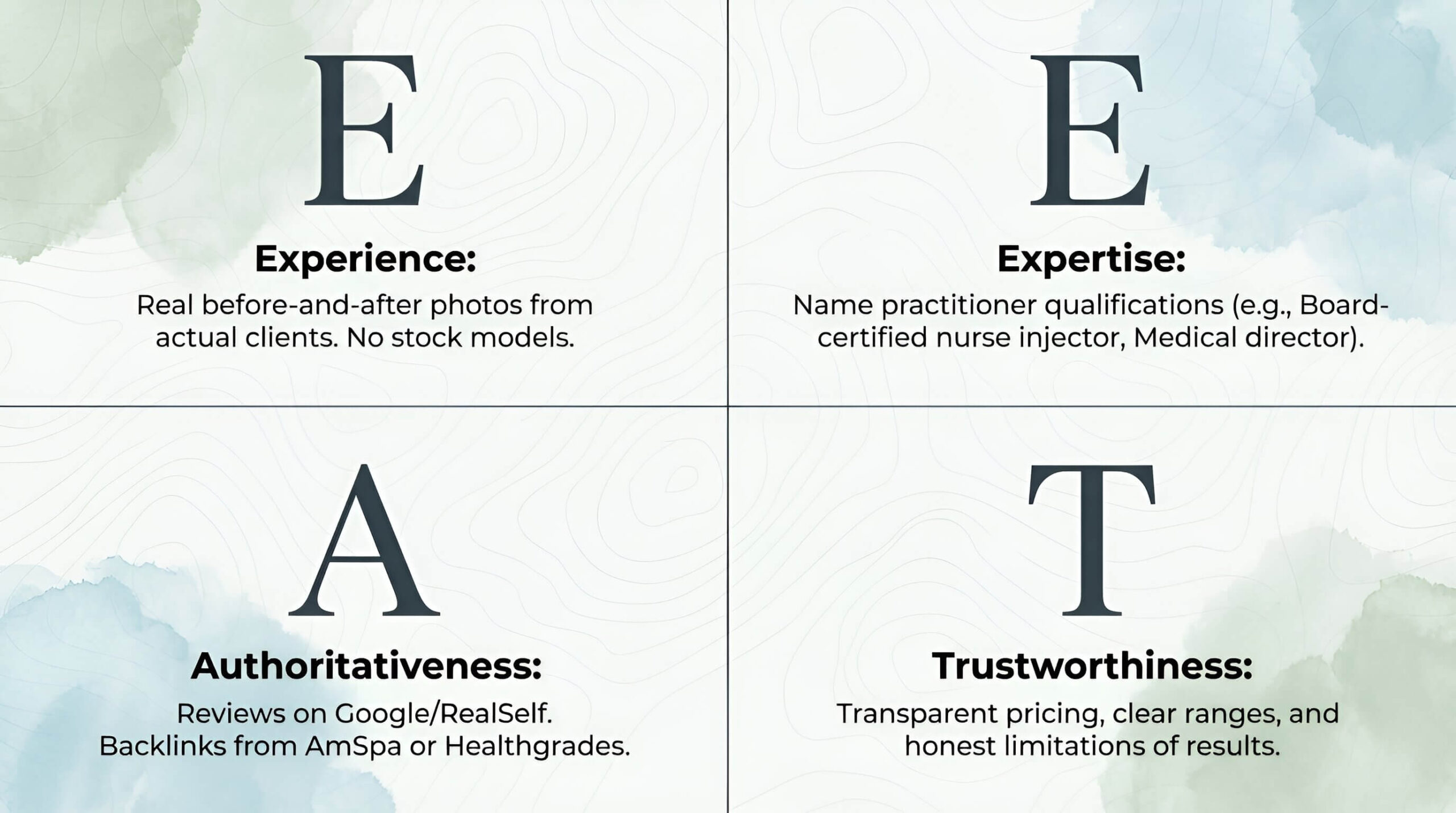
Google evaluates content using E-E-A-T: Experience, Expertise, Authoritativeness, and Trustworthiness. For most local businesses, this framework matters in a general way. For med spas, it applies at a stricter level.
Aesthetic treatments fall into what Google calls “Your Money or Your Life” content. This covers information that directly affects a person’s health or safety. Your treatment pages are held to a higher standard than most local service pages.
A page that simply describes what Botox is and asks people to book ranks below a page that demonstrates real clinical knowledge, shows who is performing the treatment, provides honest information about risks and realistic outcomes, and gives the reader reasons to trust the people behind it.
Experience: Real before-and-after results from your actual clients on your own website signal genuine experience. Stock photos of models do not.
Expertise: Every treatment page should name who performs the treatment and what qualifies them. Board-certified nurse injector. Licensed aesthetician. Medical director supervision. These are signals Google’s systems use to evaluate whether your content should rank for health-adjacent searches.
Authoritativeness: Reviews on Google and RealSelf. Mentions in local media. Links from the AmSpa directory and Healthgrades. Each external source that references your clinic adds to your authority over time.
Trustworthiness: List your pricing clearly or give a range. Be honest about what results look like and how long they last. Acknowledge limitations. Transparent pages hold attention longer, and Google measures that.
The same E-E-A-T principle shapes how healthcare-adjacent businesses approach all of their digital content, as we cover in our SEO guide for dentists in the USA.
Google Business Profile for Med Spas: The Setup Most Clinics Have Never Finished
Ask most med spa owners when they last updated their Google Business Profile and you get one of two answers. Either “when we opened” or “my receptionist handles that.”
Neither is a strategy.
Your GBP is the most visible piece of digital real estate your clinic controls. It shows your star rating, your photos, your hours, and your services before a potential client ever visits your website. A half-completed profile is one of the fastest ways to lose a booking to a competitor.
Category selection
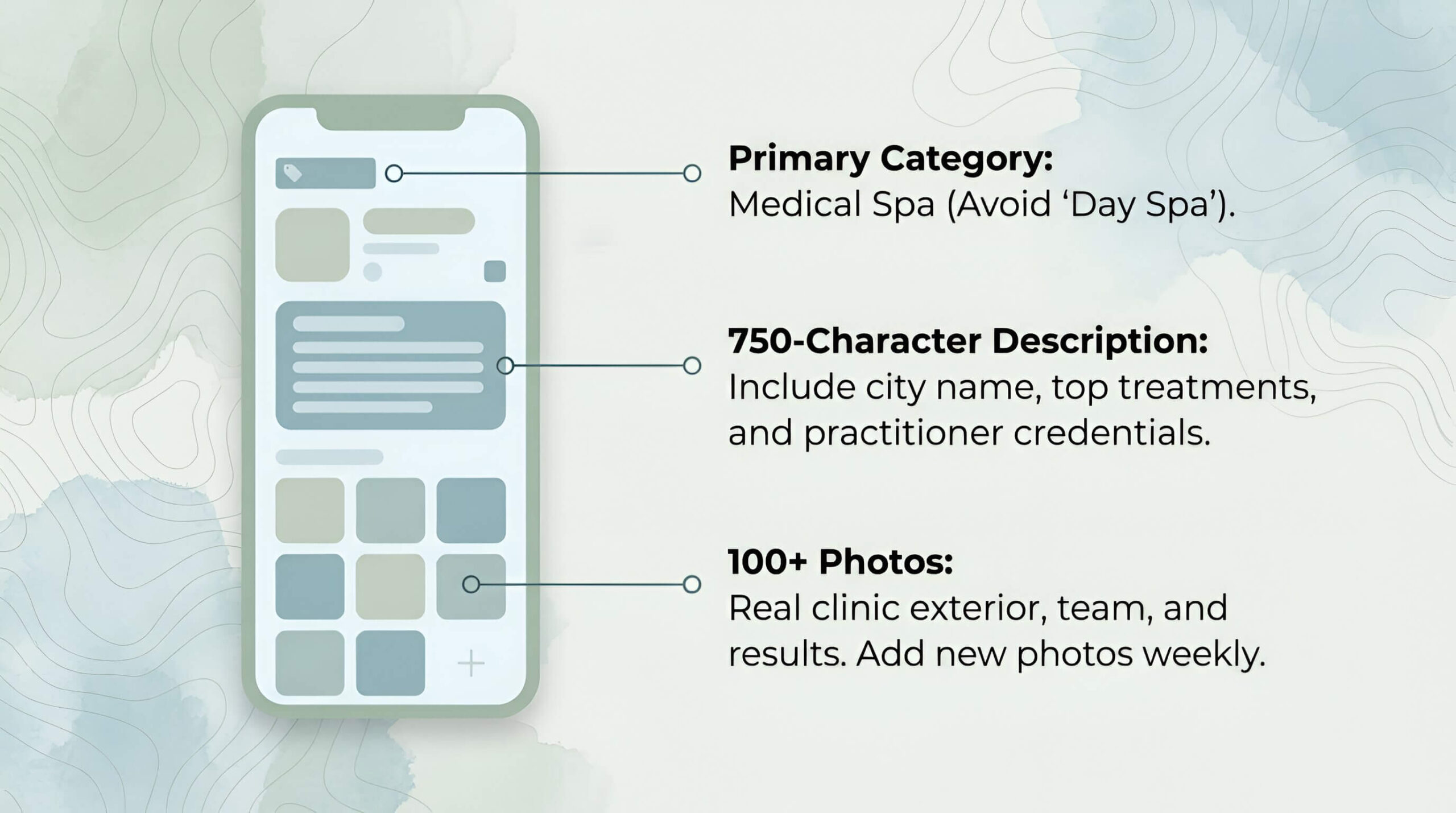
Select “Medical Spa” as your primary category. Choosing “Day Spa” as the primary will suppress your appearance for medical aesthetic treatment searches. Add secondary categories like “Skin Care Clinic” and “Laser Hair Removal Service” where they apply.
Write a description that does real work
Use your 750 characters to include your city name, your top treatments, your practitioner credentials, and one specific differentiator. Write it for a potential client on her phone, not for an algorithm.
Here is an example that works:
“Luminary Medical Spa has served clients across Austin, Texas for eight years. Our board-certified nurse injectors provide Botox, dermal fillers, HydraFacial, and laser hair removal in South Austin. We offer complimentary consultations, transparent pricing before every treatment, and same-week appointments for most services.”
The services section most clinics leave empty
GBP lets you list individual services with descriptions and starting prices. A listing that reads “Botox Injections, From $12 per unit, 20-minute appointment, zero downtime” answers the client’s first two questions before she ever calls you. Fill out every treatment you offer.
Photos, posts, and Q&A
Upload photos of your clinic exterior, reception, treatment rooms, team, and real client results with written consent. Profiles with 100 or more photos consistently receive more calls. Add new photos every week, not once at setup.
Post once or twice weekly: seasonal treatment reminders, new services, team features.
Populate Q&A yourself before anyone else does. “Are your injectors board-certified?” “Do you require a consultation before booking?” “What is your cancellation policy?” Answer these proactively.
[Is your GBP costing you bookings? Get a free audit and find out exactly what is missing.]
One Page Per Treatment: How Your Service Menu Becomes a Search Asset
Walk through almost any med spa website and you find one page called “Services” listing every treatment the clinic offers.
That structure cannot rank for any treatment specifically.
Google sends focused searchers to focused pages. When someone searches “laser hair removal in Houston,” Google looks for a page specifically about laser hair removal in Houston. A general services page mentioning it among twelve other treatments cannot rank for that search.
Building the right page structure
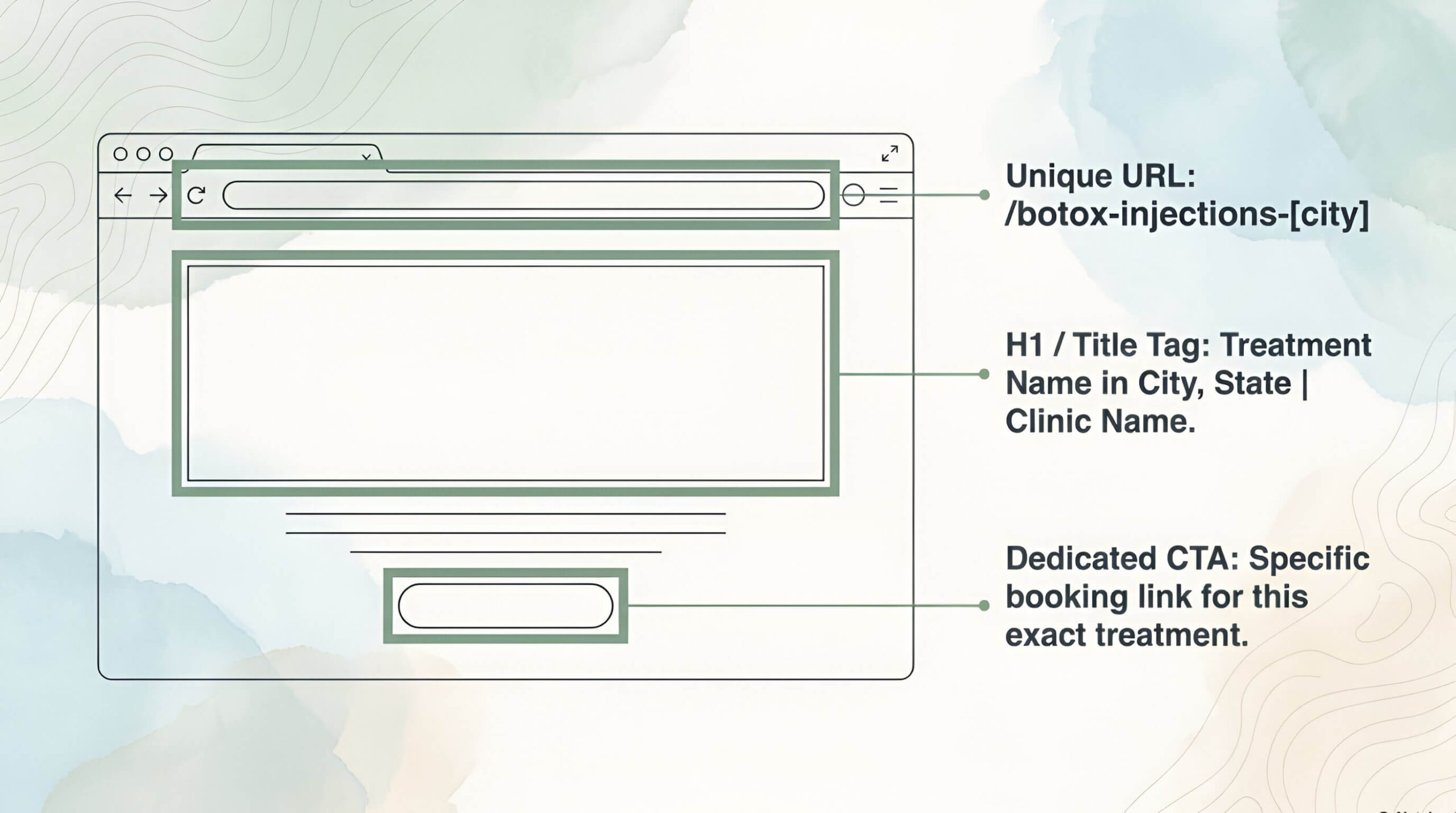
Every treatment gets its own URL:
- /botox-injections-austin
- /lip-fillers-austin
- /laser-hair-removal-austin
- /hydrafacial-austin
- /microneedling-austin
Each page targets one primary treatment keyword plus your city. Each page has its own title tag, its own H1, its own content, and its own booking call to action.
Title tag formula: Treatment Name in City, State | Clinic Name.
“Botox Injections in Austin, TX | Luminary Medical Spa” communicates the treatment, the location, and the brand in under 60 characters.
What each treatment page needs
- Treatment name and city in the H1 and first paragraph
- What the treatment does and who it is for
- Honest information about results and recovery
- Pricing or a realistic price range
- The name and credentials of the practitioner who performs it
- Before-and-after images with descriptive alt text
- Reviews that specifically mention this treatment
- Schema markup
- A booking CTA
That is a page that satisfies both Google and the high-ticket client spending $800 on injectables.
Multi-location clinics
Each location needs its own dedicated page with unique content. Not a copy of another location page with the city name swapped. Google detects near-duplicate location pages and ranks none of them well.
Before-and-After Photos as an SEO Asset: What Most Med Spas Get Wrong

Most med spas post their best before-and-after results on Instagram. The content gets engagement and disappears from reach within 24 to 48 hours.
Those same photos placed on your website, on a properly structured treatment page, with correct file names and alt text, do something completely different. They create a permanent, searchable asset that keeps generating consultation requests weeks and months after you publish them.
The technical side that makes before/after content rank
File naming matters. “botox-forehead-before-after-austin.jpg” is searchable. “IMG_7831.jpg” is invisible to Google.
Alt text matters equally. Write alt text that describes what the image shows: “Botox forehead lines before and after treatment at Luminary Medical Spa in Austin, Texas.” This is what Google reads, and it is what screen readers use for accessibility.
Placement matters most. Placing galleries on treatment-specific pages tells Google exactly which treatment each set of results relates to. A dedicated page for Botox before-and-afters, linked from your Botox service page, ranks for image searches and pulls in clients evaluating results before booking.
Getting consent right
Every before-and-after photo used on your website or GBP requires explicit written consent from the client. The consent form should specify where the images may be used. This is a legal requirement and a HIPAA-adjacent obligation for any clinic handling patient information.
Four to six varied results per treatment page build more credibility than twenty identical perfect outcomes. Real variety, different starting points, different skin types, different degrees of improvement, tells an honest and ultimately more convincing story.
Reviews, HIPAA Compliance, and RealSelf: The Reputation Stack That Ranks Med Spas
Reviews are a ranking signal and a sales tool at the same time. Your approach to reputation management needs to serve both.
A client spending $800 on injectables reads every review in detail. Not just the star count. The actual content. “Great atmosphere” does not close a high-ticket booking. “My forehead lines are gone and my injector explained every step before touching me” does.
Building a system that generates reviews consistently
The clinics that dominate local rankings do not wait for reviews to arrive. They have a system.
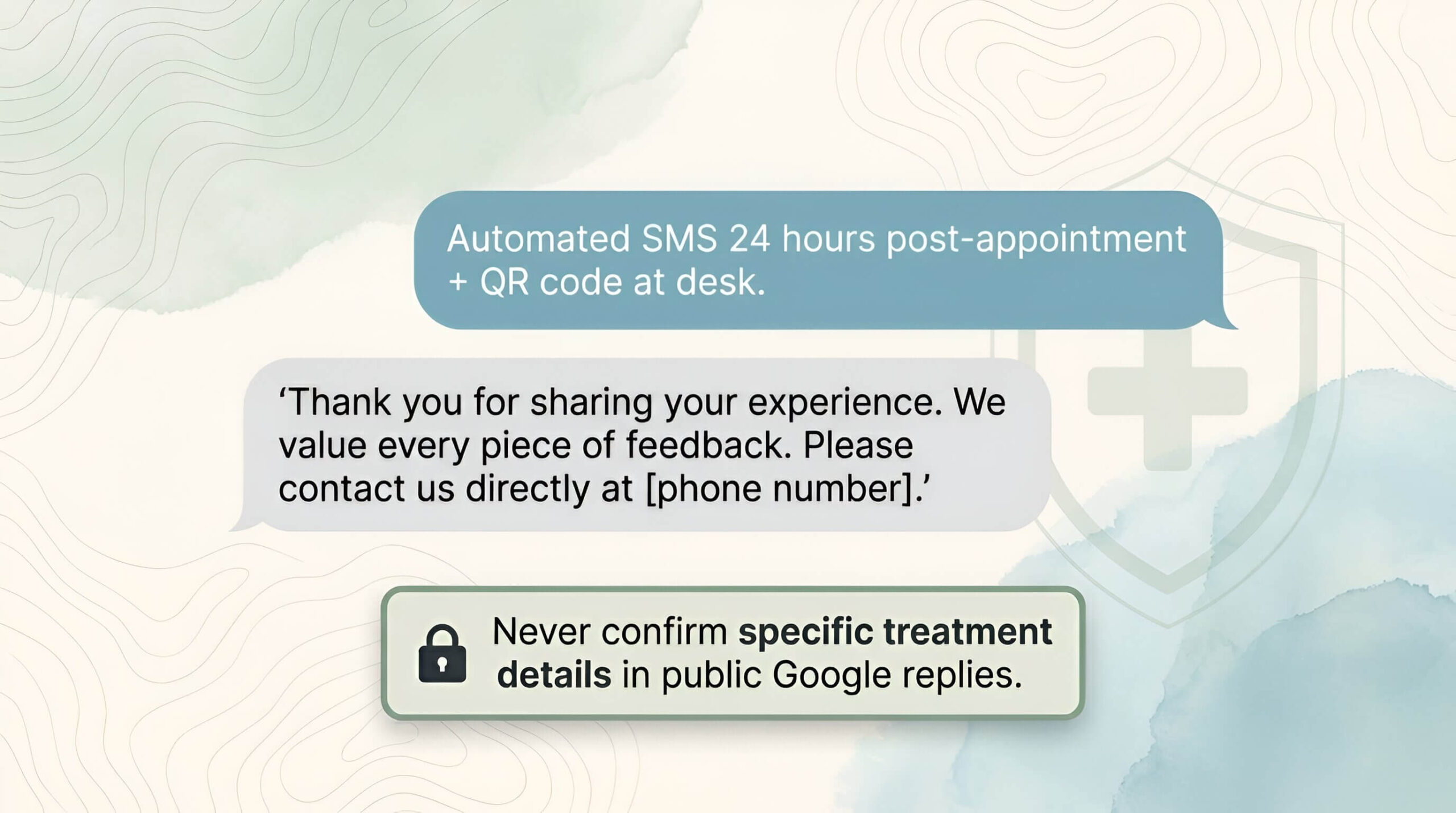
Send an automated SMS 24 hours after each appointment: “Thank you for visiting us. If your experience was everything you hoped, we would love your Google review. It helps other clients in [city] find care they can trust.”
Place a QR code on your checkout desk linking directly to your Google review page.
Brief your front desk team to mention reviews naturally when a client expresses satisfaction.
All three together produce a steady weekly flow that compounds into a real competitive advantage over six months.
HIPAA compliance in review responses: the rule most clinics do not know
Never confirm treatment details, appointment dates, procedure names, or any patient-specific information in a public Google reply.
A response that states “We are glad your Botox results exceeded your expectations” in reply to a negative review has just publicly confirmed that the person received Botox. That is a HIPAA issue, regardless of how minor it seems.
A compliant response stays professional and non-specific: “Thank you for sharing your experience. We value every piece of feedback and would like to understand more. Please contact us directly at [phone number].”
That response protects compliance and shows every other reader that your clinic handles things properly. Healthcare-adjacent businesses share this compliance responsibility across all digital touchpoints, as discussed in our guide on digital marketing for hospitals.
RealSelf: the platform your competitors have not claimed
RealSelf is not just a citation directory. It is where serious aesthetic clients go when they are close to spending significant money and want to read verified procedure reviews, ask specific questions, and compare providers side by side.
Many of your most ready-to-book clients check RealSelf before they call. If your clinic has no presence there, you are invisible at the exact moment she is making her final decision.
Claim your profile. Answer open treatment questions in your specialty areas. Encourage satisfied clients to leave a review there alongside their Google review.
The Seasonal SEO Calendar: When You Publish Matters as Much as What You Publish
Most clinics publish content when they think of it, or when business is slow. The problem with that approach is that Google rankings do not appear overnight.
A new blog post takes weeks to get indexed, evaluated, and ranked. If you publish content about wedding season skin prep in May, it might rank by July. The brides who needed that information were making their appointments in March.
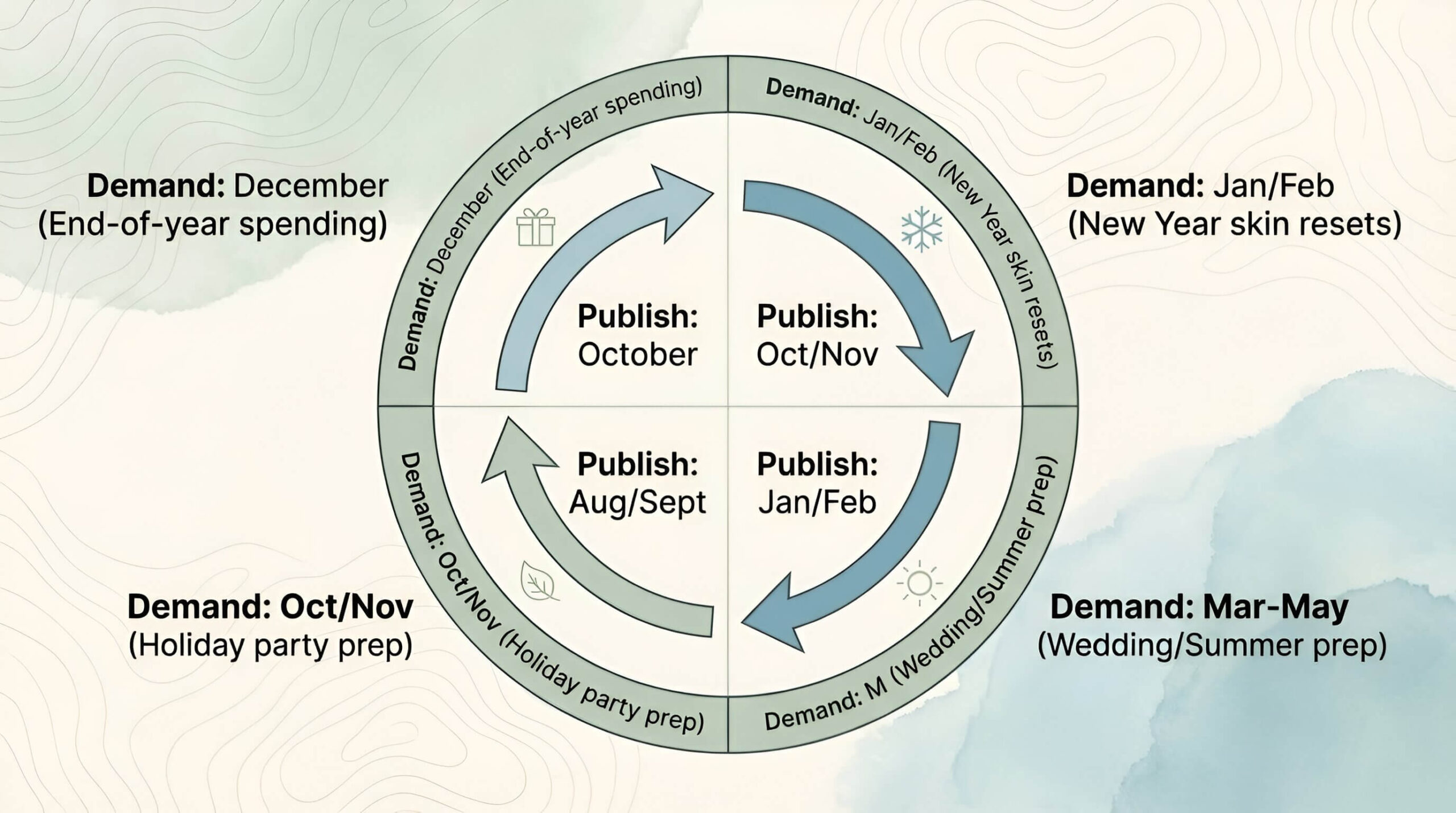
Publish 8 to 12 weeks before the demand peaks, not when the demand arrives.
The four peak demand windows for US med spas
January through February: New Year skin resets, Valentine’s Day gifting. Publish this content in October and November of the previous year.
March through May: Wedding season prep, summer body treatment cycles. Bridal skin guides, laser hair removal series, and pre-summer body contouring. Publish in January and February. By March, these pages are ranking while competitors are still drafting their content.
October through November: Holiday party prep, treatment packages, gift card promotions. Publish in August and September.
December: End-of-year spending, loyalty member offers. Publish in October.
The same seasonal demand logic drives results for wellness businesses of all types. Our SEO guide for gyms in the USA covers how the January and summer cycles drive organic traffic for fitness businesses. The same timing applies directly to med spas.
Set quarterly content planning into your calendar now. Assign each piece a publish date based on the peak it targets. Your content will be ranking before your competitors have even thought about it.
Content That Answers What Clients Research Before They Book
High-ticket aesthetic clients research before they spend. A client considering $1,200 of dermal fillers does not make that decision after seeing one Instagram post. She spends time reading about what fillers do, what the risks are, how long they last, and what results look like.
The clinic whose website answers all of those questions earns the consultation. The clinic with only a services page earns nothing from that research process.
The four content types that produce bookings
Treatment explainers target clients in the research phase. “What is microneedling and who is a good candidate” attracts clients who are already interested but want more information before deciding.
Cost transparency content is among the highest-converting content a med spa can publish. “How much does Botox cost in [city] in 2026” is searched by clients who have already decided they want Botox and are checking whether the price fits. One phone call away from booking.
Comparison content helps deciding clients choose. “Botox vs Dysport: what is the actual difference” demonstrates clinical expertise and satisfies E-E-A-T requirements at the same time.
Local content ties your clinic to your geography in ways generic content never can. “[City] bridal skin prep guide: what to book six months before your wedding” attracts local searches with high commercial intent.
20 blog ideas ready to use in 2026
- How long does Botox last and what affects the results
- Botox vs Dysport: the actual differences
- What to expect after lip fillers: the first two weeks
- How much does a HydraFacial cost in [city] in 2026
- The best age to start Botox: what injectors recommend
- CoolSculpting results at weeks 4, 8, and 12
- Is microneedling worth it for acne scars
- Dermal fillers vs Botox: which one do you actually need
- How to prepare for your first med spa appointment
- What is PDO thread lift and who is it for
- Laser hair removal: how many sessions does it actually take
- Med spa vs dermatologist for cosmetic treatments
- Chemical peel types explained and how to choose
- What happens to your face if you stop getting Botox
- How to find a board-certified injector in [city]
- Lip filler trends in 2026: what clients are booking
- IV therapy at med spas: what it actually does
- Body contouring options compared: CoolSculpting vs Emsculpt
- Pre-wedding skin timeline for [city] brides: a 6-month guide
- Signs you might need a filler touch-up
Creating and promoting content that answers specific questions at the right moment is what separates med spas that rank from those that publish and wonder why nothing changes.
Want a done-for-you 12-month content calendar mapped to aesthetic demand cycles?
Internal Linking: How to Connect Your Pages Into One Authority Signal
Internal linking is the part of med spa SEO that almost nobody talks about, and one of the fastest ways to improve how Google evaluates your entire site.
When your Botox page links to your lip filler page, and your blog post about Botox longevity links back to your Botox service page, you create a network of authority that flows across your site. Google uses these links to understand how your content is related, which pages are most important, and how authoritative your site is overall.
The structure that works
Your homepage links to your most important service pages. Each service page links to two or three related service pages and one or two relevant blog posts. Each blog post links back to the service page it relates to most closely.
A post titled “How long does Botox last” links to your Botox service page. A post about “pre-wedding skin prep in [city]” links to your Botox, filler, and HydraFacial pages.
Use descriptive link text. Not “click here” but “Botox injections in Austin” or “lip filler consultations.”
This keeps visitors moving through your site, increases session time, and passes authority from your content pages to your service pages. The same internal linking principle applies across every local service business in our USA SEO series, as shown in our SEO guide for veterinarians.
One important rule: every treatment page should be linked to from at least two other pages on your site the moment you publish it. Pages with no internal links pointing to them start from zero every time.
Technical SEO for Med Spa Websites: Four Things That Cost You Rankings
Technical SEO is not glamorous. Fix it anyway, because Google does.
Before-and-after gallery compression
Before-and-after galleries are the most important visual content on any med spa website and the most common cause of slow load speeds. One uncompressed image can weigh four megabytes. Ten of those on a single page and your site loads in six seconds on a phone. Compress every image below 200KB using TinyPNG or ShortPixel. This single change often improves mobile PageSpeed scores by 20 to 30 points.
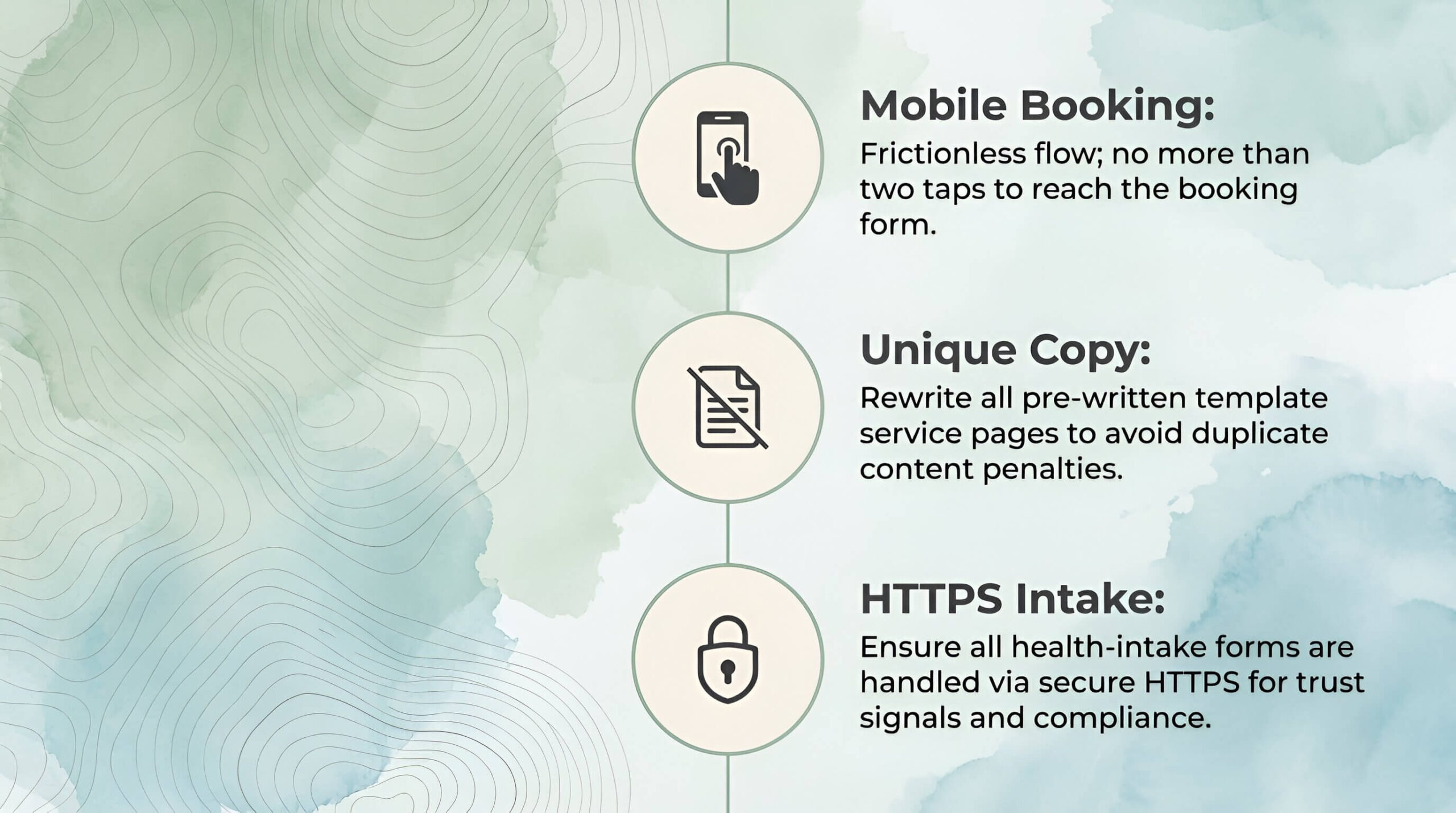
Mobile booking flow
Up to 40% of new client leads drop off during a high-friction booking process. Your booking button needs to be visible in the site header on mobile. The form needs to load fast with no redirects. A client who found you on Google and cannot reach your booking form in two taps is a lost consultation.
Duplicate content from template platforms
Many med spa websites are built on aesthetics-industry platforms with pre-written service descriptions shared across hundreds of clinics. If your Botox page reads identically to 400 others, Google ranks none of them. Rewrite every service page in your own voice with your city, your practitioners, and your actual clinical approach.
HTTPS and intake form compliance
Your URL must begin with https://. For med spas collecting health intake forms online, the data handling should be HIPAA-appropriate. Google evaluates trustworthiness signals for health-adjacent websites. Compliance matters for rankings and for every client who reads your privacy notice before submitting a form.
How to Know If Your Med Spa SEO Is Working
Most med spa owners either track nothing or track the wrong things. Follower count is not an SEO metric. The metrics that tell you whether your investment is producing return are specific and all free to access.
Google Search Console shows which search queries return your pages as results, how many searchers clicked through, and which pages are gaining or losing position. Check it weekly. Look specifically at queries containing your city name and treatment names.
Google Business Profile Insights shows how many people viewed your profile, how many discovered you through a category search versus searching your name, and how many called directly from your listing. A rising discovery number means your map pack visibility is growing.
Google Analytics 4 lets you set up conversion events for contact form completions and phone link clicks, then filter by organic search traffic only. This tells you exactly how many consultation requests your SEO produces each month, not just how many people visited.
Do not obsess over total traffic. A 40% increase in traffic means nothing if consultation requests stay flat. Track organic sessions, form completions from organic traffic, and calls from organic visitors.
Maximising the long-term return from SEO services comes down to measuring the right outcomes consistently. Clinics that track these metrics stay committed because they can see it working.
Frequently Asked Questions About SEO for Med Spas
How much does medical spa SEO cost in the USA in 2026?
Most single-location med spas invest between $800 and $2,500 per month. Competitive markets like New York, Miami, and Los Angeles sit toward the higher end. One additional $1,500 body contouring booking per week from organic search covers a full month of investment.
How long does it take to rank for Botox near me?
In a mid-competition market, expect map pack visibility within 60 to 90 days and strong ranking positions within four to six months. In highly competitive cities, dominant positioning takes 9 to 12 months of consistent work.
Does a med spa need a separate page for every treatment?
Yes. One services page listing fifteen treatments cannot rank for any of them specifically. Each treatment needs its own URL, its own title tag, its own content, and its own booking call to action. This is the structural requirement for treatment-specific rankings.
What makes medical spa SEO different from other local business SEO?
Four things make it distinct. Google’s E-E-A-T framework applies more strictly to health-adjacent content. HIPAA compliance affects how you respond to reviews publicly. Treatment claims need to comply with FDA advertising guidelines. And seasonal demand cycles require content to be published months before the demand peaks.
Can you do med spa SEO without hiring an agency?
GBP optimisation, a review request process, and basic blog publishing are manageable in-house. Technical SEO, treatment page architecture, competitive keyword research, and link building benefit from professional expertise, especially in markets where the top-ranked clinics are already working with experienced agencies.
The Clinics That Start Now Will Own Their Market by Next Year
The US med spa industry is not slowing down. More clinics open every month. Competition for local clients grows every quarter.
Most med spas in any US city have done minimal SEO work. A few have done some. Almost none have done all of it consistently. That gap is your opportunity.
Open Google on your phone right now and search for your most popular treatment plus your city. If your clinic is not in the top three map results, you have found your starting point.
Start with your GBP. Get a review system running this week. Build individual treatment pages for every service you offer. Start publishing content on a schedule tied to aesthetic demand cycles. Track what moves each month.
If you want a team that understands how local SEO works across US markets and can build and manage the full strategy for your clinic, Rank Alley works with service businesses across the United States to grow organic search visibility and generate consistent inbound enquiries month after month.