

There are 94 million pet-owning households in the United States right now.
That number grows every single year. Pet ownership in the USA hit a record high of 66% of all households in 2025, and Americans spent over $39 billion on veterinary care and products in the same year alone.
The pet care market is not slowing down. What is slowing down most vet clinics is their ability to get found by the pet owners living in their own city.
Right now, someone a few streets from your clinic is typing “vet near me” into their phone. What shows up at the top of that search is not necessarily the best clinic in the area. It is the one that has done the right SEO work.
That gap between being found and being invisible is exactly what this guide addresses.
Whether you run a small independent practice or a multi-location animal hospital, this complete guide to SEO for veterinarians walks through every practical step you need to rank on Google, fill your appointment calendar, and stay ahead of competing clinics in your city.
How Pet Owners in the USA Search for Veterinary Services
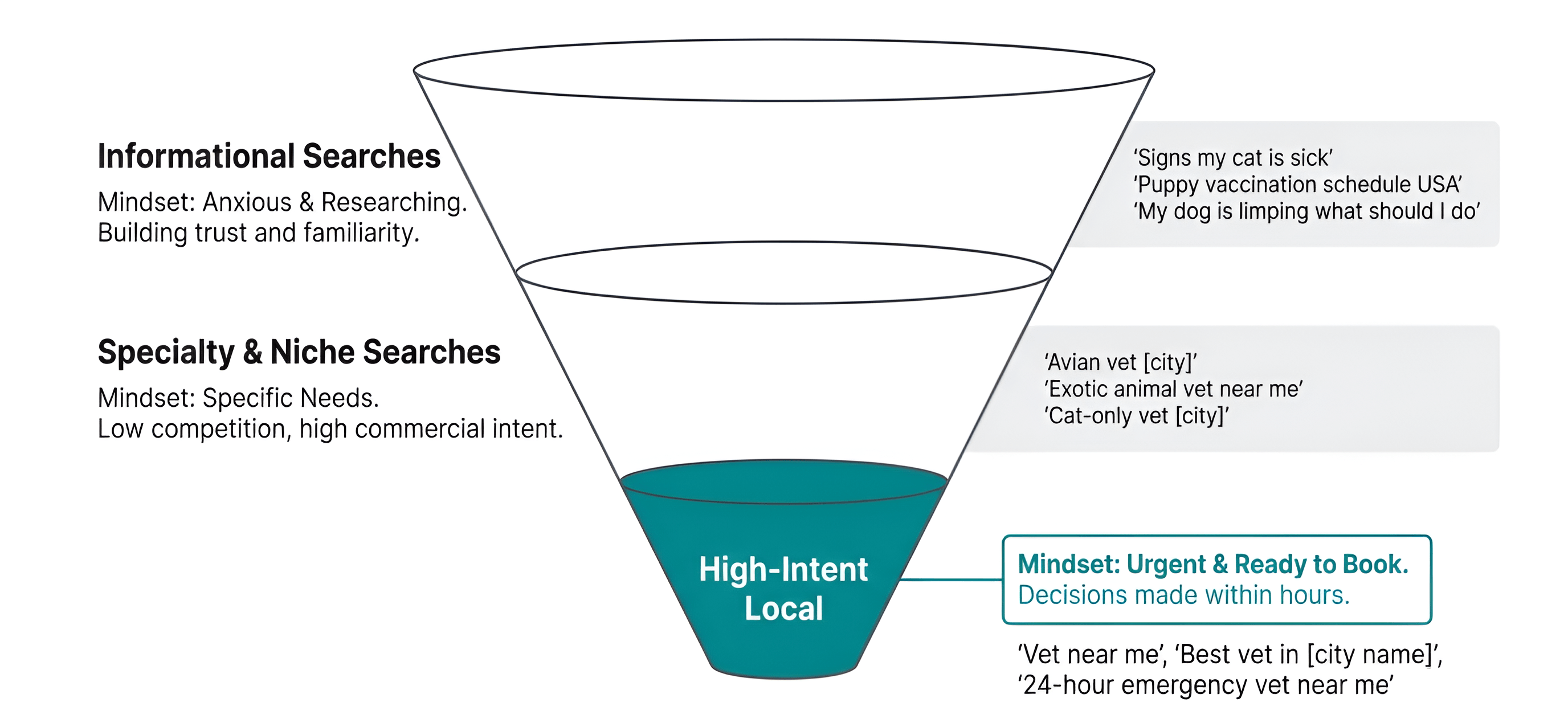
Before you change a single thing on your website, understand how pet owners actually search. The search behavior around veterinary services falls into a few clear categories, and each one represents a different kind of opportunity for your clinic.
High-intent local searches
These come from pet owners who have already decided they need a vet and are now choosing which clinic to visit. They search things like:
- Vet near me
- Best vet in [city name]
- Dog vet [neighborhood]
- Cat vet open Saturday [city]
- 24-hour emergency vet near me
Pet owners running these searches are ready to book within hours. Getting your clinic in front of them is the fastest way to grow your client base.
Informational searches
These come from pet owners earlier in the process. They are not booking yet, but they are worried about something specific:
- My dog is limping what should I do
- How much does a vet visit cost in [city]
- Puppy vaccination schedule USA
- Signs my cat is sick
Appearing for these searches builds trust and familiarity before a pet owner is even looking for a new clinic. By the time they are ready to book, your name is already the one they recognize.
Specialty and niche searches
This is where most vet clinics leave real opportunity unclaimed. Searches like “exotic animal vet near me,” “cat-only vet [city],” and “avian vet [city]” carry very low competition but extremely high commercial intent. Pet owners searching for specialty care almost always book quickly because their options are limited.
Think about what makes your practice different from the clinic three streets over. If you see rabbits, birds, or reptiles, there are people in your area actively searching for exactly that. They cannot find you yet.
What Is SEO for Veterinary Clinics?
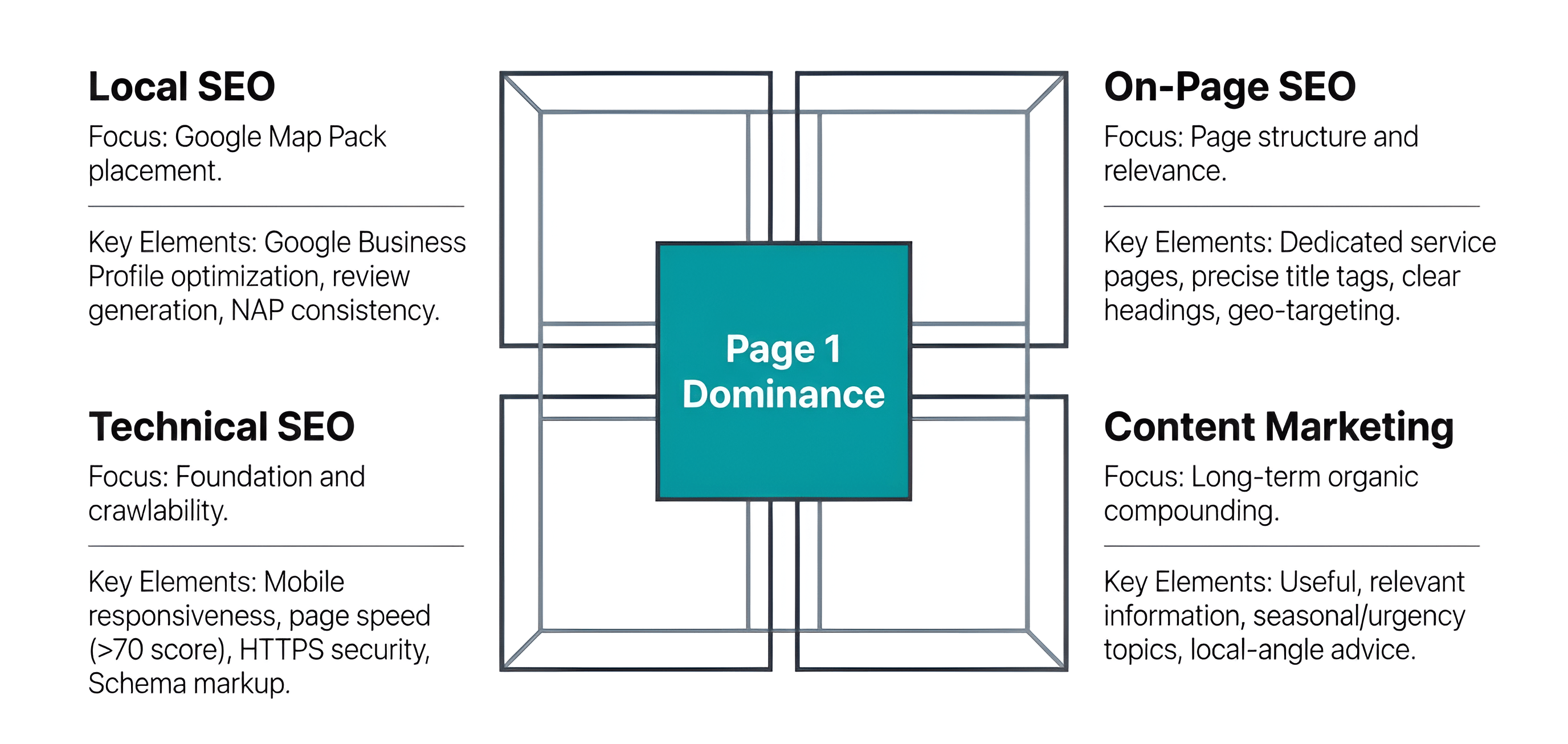
SEO for veterinary clinics is the process of making your practice visible on Google when local pet owners search for the services you provide. It is not one single task. It is a combination of four areas working together, and every area affects the others.
Local SEO
Local SEO focuses on getting your clinic into the Google Map Pack. That is the block of three listings that appears at the top of local search results with a map beside them. For any vet practice, this is the most valuable piece of online real estate available.
Most pet owners click one of those three listings and never scroll further down the page.
Your Google Business Profile, your reviews, and how consistently your clinic information appears across the web all feed into how well you perform here.
On-page SEO
On-page SEO is about how each page on your website is written and structured. This includes your headings, page titles, body content, and how clearly each page communicates what service you offer and where you offer it.
A page titled “Services” tells Google almost nothing. A page titled “Dog Vaccinations in Austin, TX” tells Google exactly what the page is about and which searches it should appear for.
Technical SEO
Technical SEO covers the foundation your website runs on. Page speed, mobile responsiveness, site security, and internal structure all fall under this category.
Google checks these signals before deciding which sites deserve strong rankings. A slow website or one that breaks on a phone costs you placements you cannot recover without fixing the underlying issue.
Content marketing
Content marketing means publishing useful, relevant information for pet owners on a consistent basis. Every blog post, FAQ page, and service page creates another entry point from search. These pages keep delivering traffic long after you publish them.
As we have seen working with service businesses across the United States, vet clinics ignore this pillar more than any other. It is also the one that produces the most sustainable long-term results.
Knowing which type of business benefits most from local SEO comes down to client geography and search frequency. Vet clinics tick both boxes completely. If you want to understand that principle further, our guide on which businesses benefit most from local SEO practices covers it in detail.
Why Most Vet Clinics in the USA Are Invisible on Google
Here is something worth pausing on.
A 2025 report from the American Veterinary Medical Association found that 83.4% of pet owners say they have a regular veterinarian. Yet only 69.4% of them actually visited a vet in the previous calendar year. That is a significant gap.
Some of it is cost-related. A large portion of it is that pet owners simply cannot find the clinic that matches what they need. They search, nothing compelling comes up, and the visit gets delayed.
The clinics that appear on page one of Google capture all of that demand. The ones sitting on page two get almost nothing.
Most vet clinics fall into one of these patterns:
- A website built years ago that has never been updated
- A Google Business Profile claimed once and never touched again
- Fewer than 30 reviews while the top competitor in town has 400
- All services listed on a single page with no local keywords
- No blog posts, no educational content, and no content strategy at all
None of these are hard problems to fix. They just require knowing what to do and doing it consistently.
Google Business Profile for Vet Clinics: Where Rankings Actually Start
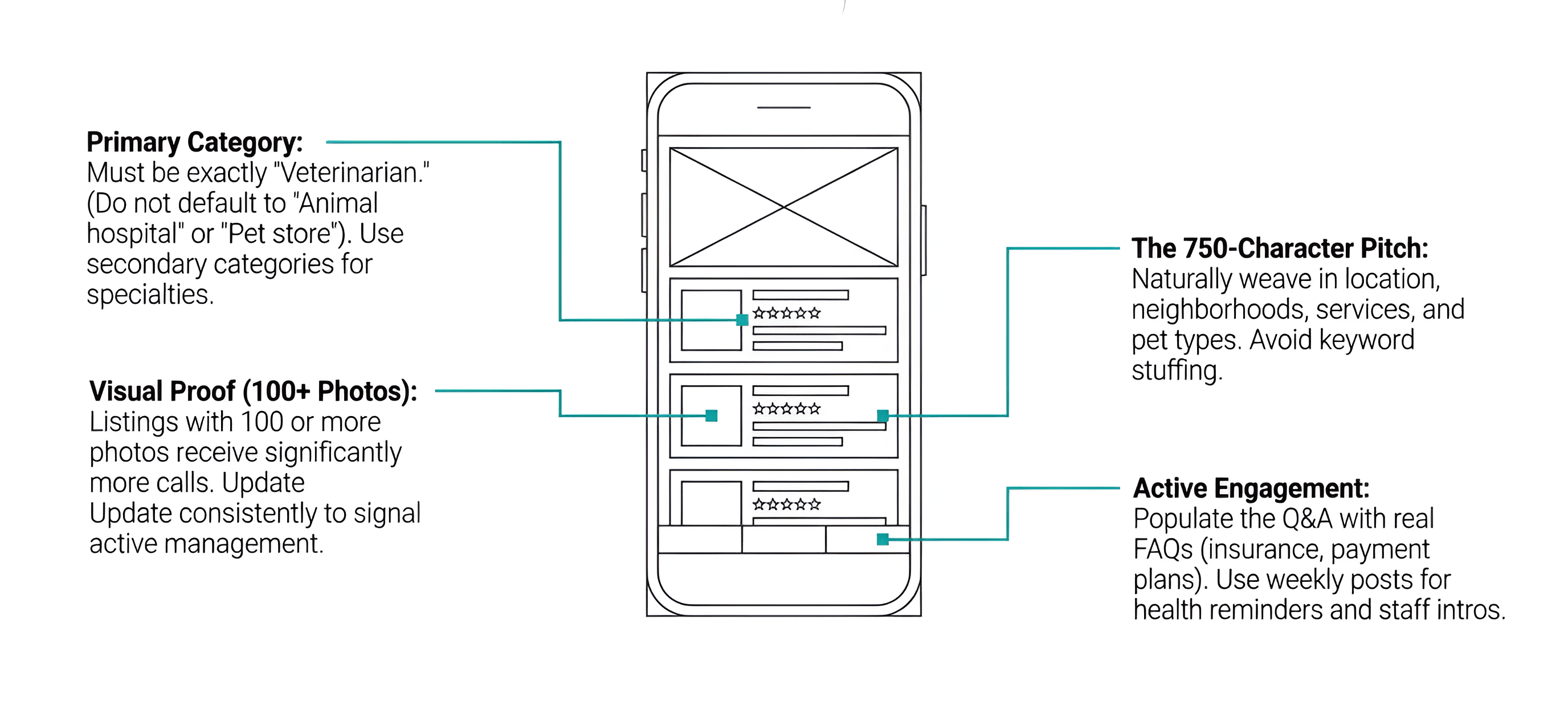
If there is one thing you take action on after reading this guide, make it your Google Business Profile (GBP).
Your GBP is what appears in the map pack when someone searches “vet near me” or “dog clinic in [city].” It shows your clinic name, review score, photos, hours, and contact details all at once. Pet owners make very fast decisions based on what they see here, often before clicking through to your website.
An optimised GBP does not take long to set up. What it does require is genuine attention to every field, not just the obvious ones.
Claiming and verifying your profile
Go to Google Business Profile and search for your clinic name. If a listing exists, claim it. If not, create one from scratch. Google will verify your ownership through a postcard or phone call.
When selecting your primary category, choose “Veterinarian.” Do not default to “Animal hospital” or “Pet store.” The primary category is one of the most direct signals Google uses to determine which searches trigger your listing.
For secondary categories, add “Emergency veterinarian service,” “Animal hospital,” or “Veterinary pharmacy” where those services apply. Secondary categories expand the range of searches your profile appears for without diluting your primary category signal.
Writing a GBP description that actually works
Your GBP description allows up to 750 characters. Use them well.
Write clearly about your services, which animals you treat, and where your clinic is located. Mention your city and neighborhood name naturally. Do not overload the description with repeated keywords, but do not treat this field as an afterthought either.
Here is what a strong GBP description looks like in practice:
“Happy Paws Veterinary Clinic has served pet owners in Denver, Colorado for over 15 years. Our team provides wellness exams, vaccinations, dental cleanings, surgery, and urgent care for dogs, cats, rabbits, and small mammals. We accept same-day appointments for urgent cases and offer upfront pricing before any procedure. Our clinic sits in the Highland neighborhood, just off 32nd Avenue.”
That covers location, services, pet types, and a clear value proposition without sounding like it was written for a search engine.
Photos matter far more than most clinics realize
Listings with 100 or more photos receive considerably more calls and direction requests than those with fewer. Upload photos of your clinic exterior, waiting area, examination rooms, your team, and satisfied patients. Always get owner permission before posting any recognizable animal or person.
Keep adding photos consistently over time. A listing that only has photos from 2021 signals neglect to Google and to every potential client who looks at it.
GBP posts: the feature almost no vet clinic uses
Google lets you publish short posts directly on your listing. Use these for seasonal pet health reminders, new service announcements, staff introductions, or appointment availability updates during busy periods.
Posting once or twice a week keeps your listing fresh and signals to Google that your business is active and relevant.
Taking control of the Q&A section
Anyone can add a question and answer to your GBP listing. Do not leave this open to chance. Add your own questions and answers covering what pet owners always want to know before calling:
- Do you see exotic animals?
- Do you offer payment plans?
- What are your emergency care hours?
- Which pet insurance plans do you work with?
When you populate this section yourself, you control the first impression before a pet owner ever visits your website.
On-Page SEO for Vet Clinic Websites
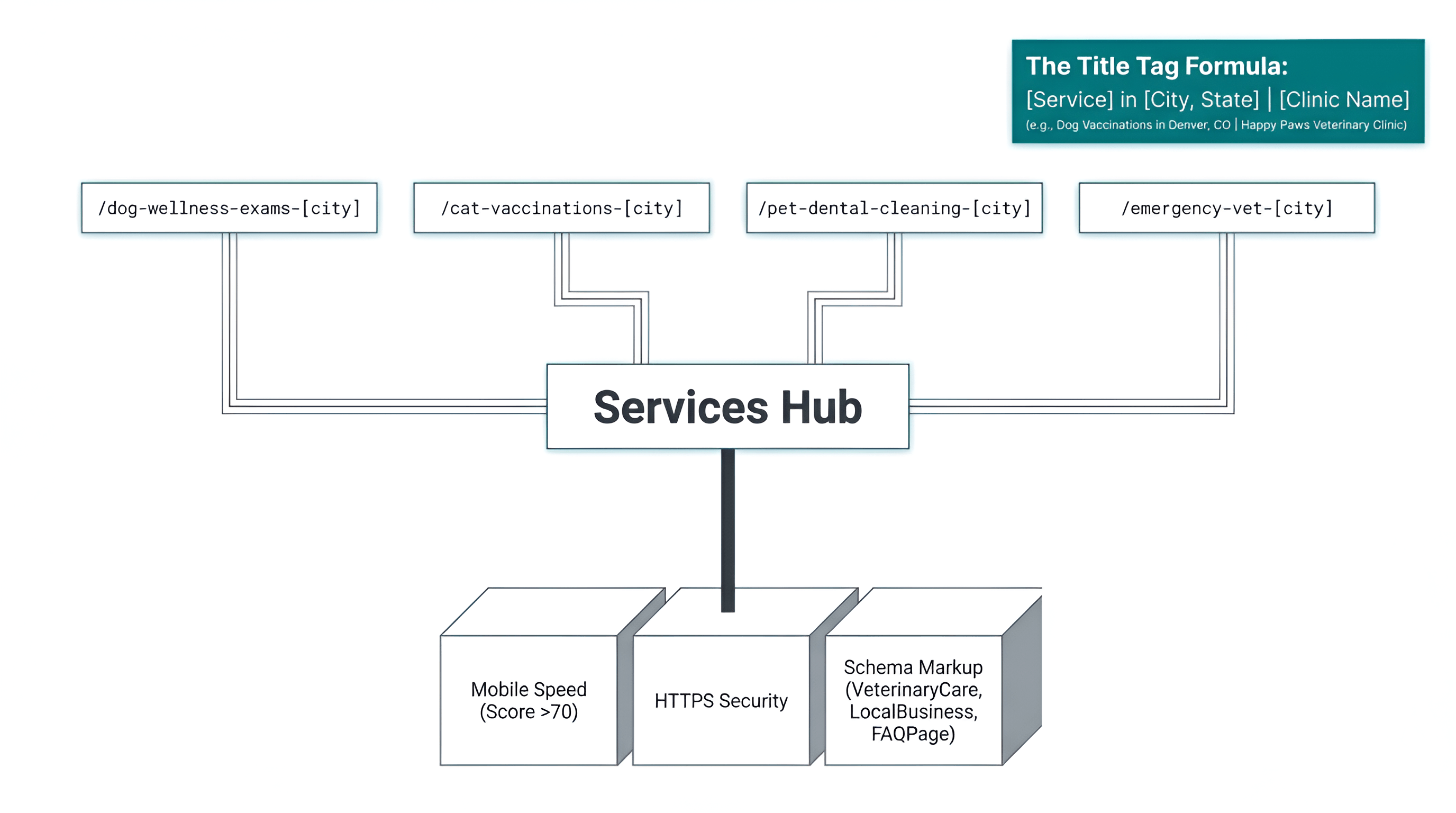
Your website needs to do more than look professional. It needs to speak directly to what pet owners in your city are actually searching for, and it needs to be structured in a way that Google can read and reward.
Create a separate page for each core service
This is the single biggest structural change most vet clinic websites need.
A website that lists “Wellness exams, vaccinations, dental cleanings, surgery, urgent care” all on one services page is leaving significant ranking potential unused. Each service needs its own dedicated page with a keyword-focused title, original content, and a clear location signal.
For example:
- /dog-wellness-exams-[city]
- /cat-vaccinations-[city]
- /pet-dental-cleaning-[city]
- /emergency-vet-[city]
When a pet owner searches “cat vaccinations in Chicago,” Google can only send them to a page that specifically covers cat vaccinations. A generic services page will not rank for that term.
Writing title tags that tell Google what you do
Your page title is one of the strongest on-page ranking signals available to you. Use this formula consistently:
[Service] in [City, State] | [Clinic Name]
For example: Dog Vaccinations in Denver, CO | Happy Paws Veterinary Clinic
That title tells Google the service, the location, and the brand. It also tells the searcher immediately that the result matches their city, which improves click-through rate directly.
Schema markup for vet practices
Schema markup is structured code that gives Google additional information about your practice in a format it can easily read and display.
For vet clinics, three schema types make the most meaningful difference:
- VeterinaryCare schema tells Google exactly what type of medical practice you run
- LocalBusiness schema confirms your address, phone number, and hours
- FAQPage schema turns your frequently asked questions into expandable rich results that appear directly in search
Modern SEO plugins like Yoast and RankMath make adding schema straightforward without any coding knowledge.
Online Reviews: The Trust Signal That Drives Veterinary Bookings
Think about what is really at stake when a pet owner chooses a vet.
They are trusting you with an animal they consider family. Research from the AVMA confirms that 97% of pet owners view their pets as family members. The decision to choose a new clinic is emotional, and it is heavily influenced by what other pet owners have already said publicly.
A clinic with 4.9 stars and 350 reviews wins over a clinic with 4.2 stars and 40 reviews in almost every situation, even if the lower-rated clinic is physically closer or slightly cheaper.
Building a consistent review flow
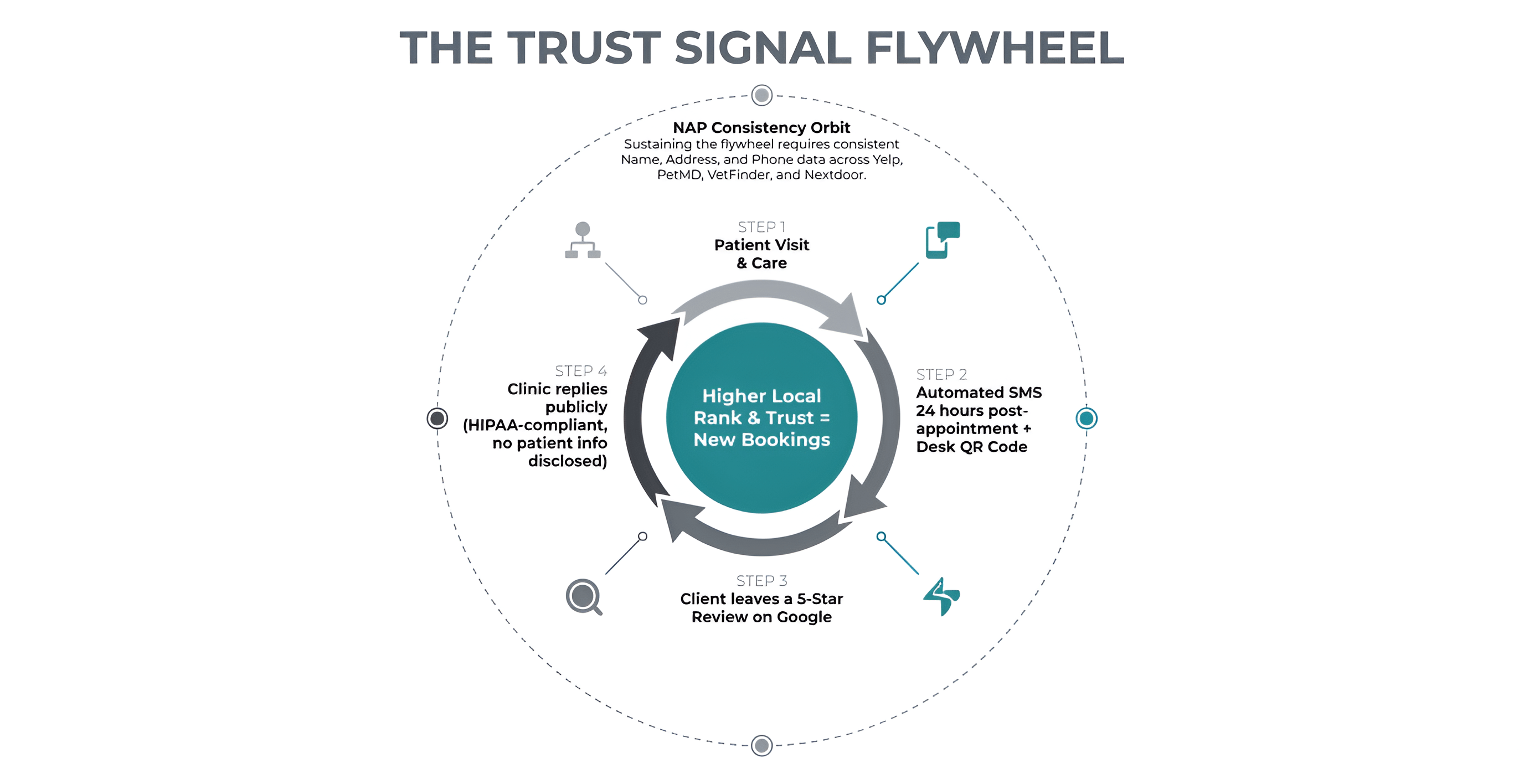
The clinics that dominate local search rankings in any US city share one characteristic: they have an active, consistent review acquisition strategy. Reviews do not arrive reliably on their own.
A practical system that produces results:
- Send a follow-up text message 24 hours after an appointment. Keep it direct and genuine. Something like: “Thank you for visiting us today. If your experience was positive, we would love it if you left us a Google review. It helps other pet owners in [city] find care for their animals.”
- Place a QR code linking to your Google review page on your front desk display and on printed receipts.
- Train front desk staff to mention reviews naturally at checkout when a client expresses satisfaction.
Never offer discounts, free services, or gifts in exchange for reviews. Google’s policies prohibit incentivized reviews and the penalties for violations are significant.
Responding to negative reviews without creating bigger problems
Negative reviews happen to every clinic eventually. Your response tells potential clients far more than the original complaint does.
Always respond quickly and professionally. Never include any specific patient information in your public reply. This matters for HIPAA compliance as much as for public perception. A response that handles this correctly looks like:
“Thank you for sharing your feedback. We take all client concerns seriously and would like to understand your experience better. Please get in touch with us directly at [phone number] so we can speak with you personally.”
That response shows attentiveness and professionalism without disclosing protected information.
On review velocity: collecting 50 reviews in one month and nothing for the following six months appears unnatural to Google. A steady flow of reviews throughout the year always performs better than bursts followed by silence.
Local Citations and NAP Consistency for Veterinary Practices
Local citations are any online listing that mentions your clinic’s name, address, and phone number. Google cross-references these listings to confirm that your business information is accurate and consistent. Consistent citations strengthen your local ranking signals. Inconsistent ones create confusion that suppresses your visibility.
The directories that matter most for USA vet clinics include:
- Google Business Profile (the most critical by a significant margin)
- Yelp
- PetMD
- VetFinder
- Pawlicy Advisor
- Nextdoor
- Yellow Pages
- Facebook Business
- Bing Places
- American Animal Hospital Association (AAHA) directory
The most common citation issue we find when auditing vet clinic accounts is an outdated phone number still appearing across listings that were never updated after a number change. That small inconsistency creates a measurable negative impact on local rankings over time.
Tools like BrightLocal or Moz Local let you audit all your citations from a single dashboard and flag any inconsistencies. Fixing them is a few hours of direct work across each directory, but the impact on local visibility makes it worth doing early.
Content Marketing for Vet Clinics: The Long-Term Play That Compounds
Pet owners are some of the most active information-seekers on the internet. They search constantly about their animals’ health, behavior, costs, and care routines. Your clinic website can capture a meaningful share of those searches if you publish the right content consistently.
The mistake most clinics make is producing generic pet care articles. Content like “10 Tips for a Healthy Dog” exists on thousands of websites. It rarely ranks because it offers nothing specific to your expertise, your location, or your clients’ actual questions.
What works is a mix of four content types working together.
Seasonal content
Reaches pet owners at the exact moments they need specific information. “Flea and Tick Prevention for Dogs in Texas: What Pet Owners Need to Know This Spring” speaks directly to a real concern in a real location during a real window of time.
Urgency-based content
Reaches pet owners in a moment of worry. “Signs Your Dog Needs a Vet Immediately” or “How to Tell If Your Cat’s Vomiting Is an Emergency” connects with pet owners when they are anxious and actively searching. Being the clinic that gave them clear, trustworthy information leaves a strong first impression.
Cost-transparency content
Answers the question nearly every potential new client has before booking. “How Much Does a Dog Wellness Exam Cost in [City]?” ranked for your city positions your clinic as open and approachable, which removes the hesitation that stops many pet owners from making the call.
Local-angle content
Most underused type and one of the most effective. An article like “Dog-Friendly Parks in [City]: What Vaccines Your Dog Needs Before Visiting” blends practical pet care advice with genuine local relevance. It attracts highly targeted traffic from pet owners in your precise area who are actively engaged with their pet’s wellbeing.
The same content principles apply across health service businesses. If you want to see how a similar approach works for dental practices, our guide on SEO for dentists in the USA covers the framework in a comparable context.
Aim for at least two new blog posts per month. Consistency matters more than volume. A clinic that publishes steadily over 12 months will outperform one that publishes 20 posts in a sprint and then stops.
If you want professional support building and executing a content strategy that works for your vet clinic, our team at Rank Alley works with service businesses across the United States to grow organic visibility and generate consistent inbound enquiries.
Technical SEO for Vet Clinic Websites: A Practical Checklist
Technical issues are the silent problems in vet clinic SEO. A practice can have a great Google Business Profile and well-written content but still struggle to rank because the website itself has problems that Google cannot ignore.
Run through this checklist for your own site:
Mobile performance Your website must load fast and display cleanly on a smartphone. The majority of “vet near me” searches happen on mobile devices. If your site loads slowly or forces users to pinch and zoom to read content, they leave immediately.
Page speed Test your website using Google PageSpeed Insights. Aim for a score above 70 on mobile. The most common issue on vet clinic websites is large, uncompressed images. Team photos and clinic interior shots are usually the main culprit. Compress all images before uploading them.
HTTPS security Your website URL must begin with “https://” not “http://.” An SSL certificate is a basic requirement. Google flags non-secure websites in search results, and pet owners who see a “Not Secure” warning in their browser close the tab without reading a word.
Duplicate content Many vet clinic websites use template content provided by veterinary web design platforms. If your “about us” section and service descriptions are identical to dozens of other clinics using the same template, Google cannot determine which version to surface. Write original content for every page on your site.
Broken links Use a tool like Screaming Frog or Ahrefs to crawl your website for broken links. A link that leads to a 404 error wastes the ranking authority you have built and frustrates users who follow it.
These are not glamorous tasks. Fixing them does not feel as rewarding as launching a new content campaign. Without this foundation in place, every other SEO action you take produces weaker results than it should.
Common SEO Mistakes Vet Clinics Make in the USA
After working with service businesses across the United States, these are the patterns that consistently hold vet clinics back from ranking where they deserve to be.
Targeting every service and every area on a single page
A homepage that reads “We provide dog care, cat care, exotic animal services, and emergency care across the Greater Houston area” is too broad to rank for anything specific. Google needs focused pages to show focused results.
Having no system for generating reviews
The top-ranked vet clinic in almost every US city has hundreds of Google reviews. Most of them did not accumulate by accident. There is a deliberate, consistent system behind them. Without one, you are falling behind competitors who have one.
Ignoring Google Business Profile after the initial setup
Claiming a GBP listing once and never returning to it is one of the most widespread mistakes we see. An inactive listing with sparse photos, no recent posts, and empty Q&A sections sends a weak signal to Google and a poor first impression to every pet owner who sees it.
Using a website that has not been updated in years
An outdated site with poor mobile performance, no schema markup, and unchanged content from 2018 is very difficult to rank in any competitive local market, regardless of how much you invest in other areas.
Publishing generic content with no local connection
Content that could apply to any vet clinic in any city will never outrank content written specifically for your city, your services, and your clients’ actual situations.
Relying entirely on word-of-mouth for new clients
Referrals are valuable but completely unpredictable. A pet owner who relocates to your city has no personal network to ask. They open Google and search. If your clinic is not visible there, you simply do not exist to them.
How Long Does Vet Clinic SEO Take to Show Results?
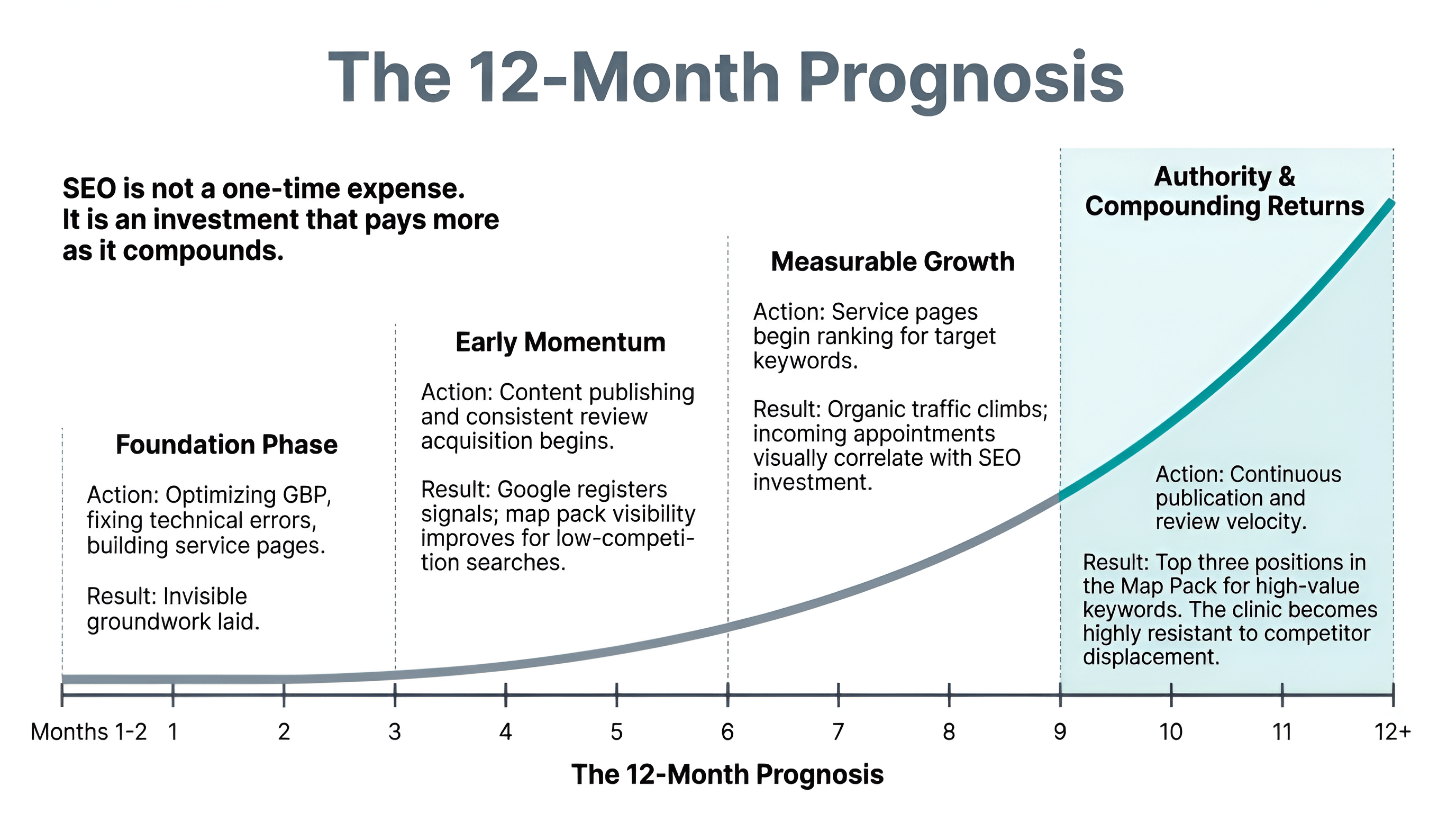
SEO is not an instant outcome. It is a process that compounds month by month. Knowing what to expect at each stage helps you stay committed through the early period when changes are happening but rankings have not fully responded yet.
Months 1 to 2: Foundation phase
This window covers the work that has to happen before rankings can improve. Fully optimising your Google Business Profile, fixing technical issues, building out service pages with appropriate keywords, and getting citation listings consistent. You may see small early movements in local search, but this phase is primarily about laying a reliable foundation.
Months 3 to 4: Early momentum
With the foundation in place, content starts publishing and review requests begin going out consistently. Google starts registering the signals your clinic is now sending. Map pack visibility often improves noticeably during this window, particularly for lower-competition searches.
Months 5 to 6: Measurable growth
Organic traffic from search starts increasing in a way you can see in your analytics. Service pages begin ranking for their target keywords. New client enquiries arriving through Google start to rise. This is the phase where the connection between SEO investment and incoming appointments becomes visible.
Months 6 to 12: Authority and compounding returns
The more consistently you publish content and build your online presence, the harder your rankings become for a competitor to displace. Clinics that stay committed through this phase regularly reach the top three positions in the Google Map Pack for multiple high-value keywords in their city.
Veterinarian SEO is not a one-time expense. It is an investment that pays more as it compounds. The clinics that start now will be in a position that is very hard for a competitor starting next year to close quickly.
Frequently Asked Questions About SEO for Veterinarians
How much does SEO cost for a vet clinic in the USA?
Most vet clinics investing in professional SEO spend between $800 and $2,500 per month. The range depends on your city’s competition level, the size of your practice, and how much content and technical work is included in the scope. Clinics in major metros like New York, Los Angeles, or Chicago generally require a higher investment than those in mid-sized cities.
Can I do vet clinic SEO myself?
Some elements are absolutely manageable without outside help. Optimising your Google Business Profile and setting up a review request process are two things any practice can implement directly. Technical SEO, content strategy, link building, and competitive analysis typically benefit from professional expertise, especially in markets where your competitors are already working with experienced agencies.
How do I get my clinic into the Google Map Pack?
Three signals drive Map Pack rankings: relevance (does your listing match what the searcher wants), proximity (how close your clinic is to the searcher), and prominence (how well-established and trusted your business appears online). Proximity is outside your control. Relevance and prominence are entirely within it, through your GBP optimisation, review count, citation consistency, and website authority.
What keywords should a vet clinic target first?
Start with service-plus-location combinations: “dog vet in [city],” “cat vaccinations [city],” “emergency vet [city].” Then expand into informational keywords around common pet health questions your clients ask regularly. Specialty searches like “exotic pet vet [city]” often have very low competition and very high booking intent.
Is a blog worth the effort for a vet clinic?
Yes. Pet health content ranks well because it answers specific questions that pet owners genuinely have and search for frequently. A clinic that publishes useful content consistently builds trust with potential clients, attracts new visitors who have not heard of the practice yet, and gives Google more reasons to surface their website across a wider range of searches.
How is vet clinic SEO different from other healthcare SEO?
The emotional dimension is considerably higher. Pet owners read reviews more carefully and place enormous weight on what other animal owners have experienced. Specialty niches like exotic animals or cat-only practices create unique keyword opportunities that do not exist in other healthcare sectors. Seasonal demand patterns tied to animal health cycles, flea season, holiday travel, and puppy adoption surges also create content opportunities that most clinics are not capitalizing on yet. For a useful comparison, see how similar dynamics play out in our guide on digital marketing for healthcare.
What to Do Next
The pet care industry in the United States is worth over $150 billion annually. A meaningful share of that flows through veterinary clinics, and the practices that rank on Google capture a disproportionate share of new clients in their area.
Most vet clinics in any US city have done little to no SEO work. That gap represents a real opportunity for the practice that moves first.
Start with your Google Business Profile. Get a review request process in place. Build out dedicated service pages. Publish content that answers the questions pet owners in your city are actively searching for.
If you want a team that understands local SEO for USA-based service businesses and can build and manage the full strategy for you, Rank Alley works with businesses across the United States to grow organic search visibility and generate consistent inbound enquiries month after month.